
A good Field Service Engineer does more than just solve a breakdown. Especially within machine building and industrial automation, a Field Service Engineer is expected to work independently, analyse technical problems quickly and communicate professionally with customers.
When a production line comes to a standstill, technical knowledge is very important. But just as important are experience, problem-solving skills, communication with the customer and the client, and the ability to remain calm under pressure.
What are the key qualities of a good Field Service Engineer?
A professional Field Service Engineer combines technical knowledge with strong personal qualities.
Ability to work independently
Field Service Engineers often work on-site at customer locations, sometimes thousands of kilometres from home. There is not always a colleague or specialist available to consult with immediately.
That is why a Field Service Engineer must be able to work independently to:
- analyse breakdowns
- make technical decisions
- set priorities
- plan activities
- implement solutions
- communicate with the customer
- take responsibility
Independence is therefore one of the most important qualities of an experienced Field Service Engineer.
Analytical and problem-solving skills
A breakdown is not always caused by the component that initially generates the fault message. For example, a sensor may be functioning correctly while the actual cause of the problem is mechanical. A PLC alarm may be the result of a problem with the wiring, a frequency drive or a mechanical blockage.
A good Field Service Engineer therefore looks beyond the fault message. He asks the customer the right questions, checks the available information and works systematically from cause to solution. He does not simply replace components; he investigates why the machine is not working.
Technical knowledge is important, but breadth is just as valuable
A Field Service Engineer in machine building usually works across a range of technical disciplines.
These include:
- electrical engineering
- industrial automation
- PLC control systems
- HMI systems
- frequency drives (Yaskawa, Rexroth)
- servo motors and servo drives
- sensors and actuators
- networks
- pneumatics
- mechanical drives
- electrical schematics
- software, diagnostics and parameters
A Field Service Engineer does not need to be a specialist in every field. A broad technical foundation is what makes it possible to recognise connections between different systems.
Is work experience more important than education?
Technical education provides an important foundation. This could include Electrical Engineering, Mechatronics, Mechanical Engineering or Industrial Automation. However, within Field Service, practical experience often becomes increasingly important as an engineer gains more experience.
Practical experience teaches you how to apply those principles in the real world
A service technician with many years of experience in machine building has often dealt with hundreds of breakdowns, installations and commissioning projects. This creates practical knowledge that cannot be gained from education, courses or textbooks alone. An experienced technician, for example, recognises patterns in faults and knows which checks are most useful to perform first.
That is why a Field Service Engineer with an MBO-level technical education and 20 years of relevant practical experience can, in many situations, be more effective than someone with a higher technical degree but little practical experience.
Education and experience complement each other
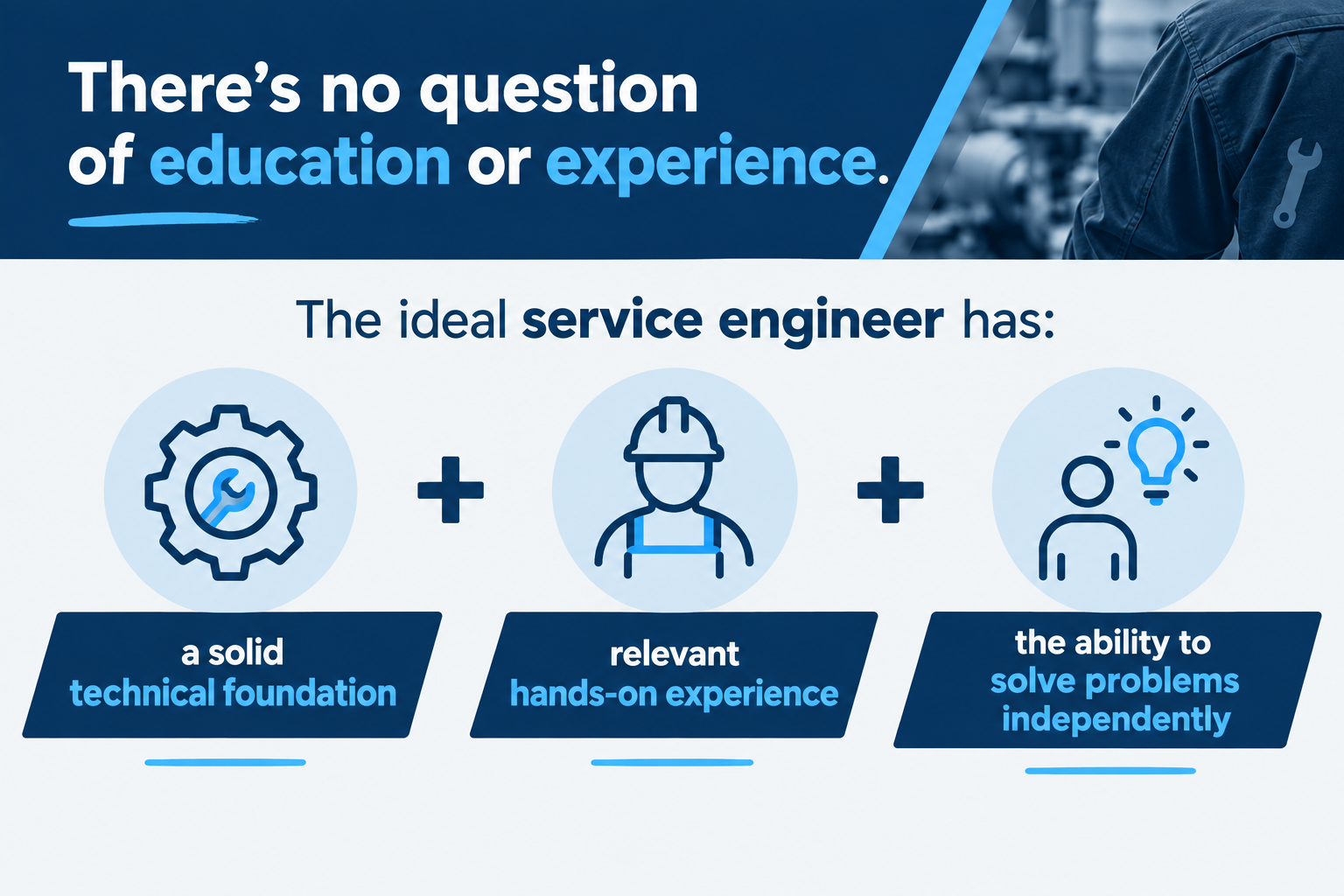
It is therefore not a question of education versus experience.
A good Field Service Engineer has:
a solid technical foundation +
relevant practical experience +
the ability to solve problems independently
For junior Field Service Engineers, education is important. For senior engineers, proven practical experience often becomes more important.
Communicating with customers
Technical knowledge alone is not enough. A freelance Field Service Engineer works at the customer's site and represents the company that commissioned the work.
This means being able to communicate with different people:
- machine operators
- maintenance technicians
- maintenance departments
- maintenance managers
- production managers
- project engineers
- service managers
- project managers
A good Field Service Engineer can explain a technical problem without using unnecessarily complicated technical terminology.
And listening is just as important. An experienced machine operator can provide information that is not found in an electrical schematic or PLC programme. By listening carefully, an engineer can sometimes identify more quickly when and under what circumstances a fault occurs.
Persuasiveness and Technical Advice
A good Field Service Engineer needs more than just technical knowledge and problem-solving skills. Persuasiveness is also important.
On site, an engineer regularly encounters situations where the customer has a different solution in mind. For example, a customer may want to replace a component as quickly as possible, while the diagnosis shows that the actual cause lies elsewhere. An experienced Field Service Engineer must then be able to clearly explain why a different approach would be more appropriate.
Persuasiveness does not mean imposing your opinion on the customer. It is about being able to support your technical assessment with solid reasoning and explain it clearly.
A good Field Service Engineer can:
- clearly explain and support their technical findings
- explain why a particular solution is necessary
- convince the customer to choose a safe solution
- explain different solutions and the associated risks
- push back when a proposed solution is not advisable
- remain calm when the customer demands a quick solution under time pressure
- take responsibility for their technical advice
This is particularly important when dealing with complex faults or machine downtime. The customer expects the Field Service Engineer not only to get the machine running again, but also to explain what is happening, why the problem occurred, and which solution is the best.
Sometimes, a Field Service Engineer also needs to be confident enough to say: "We can repair this now, but that won't solve the root cause."
In addition to technical knowledge, this requires confidence, experience and persuasiveness.
Staying calm when production is down
Field Service can be highly stressful. When a production line is down, every minute can mean lost production. The customer wants a solution as quickly as possible.
A professional Field Service Engineer does not allow this pressure to affect his judgement. He remains calm, works systematically and keeps the customer informed of progress.
Staying calm under pressure does not mean that a breakdown is not stressful. It means that you continue to perform effectively under pressure.
International Field Service requires extra flexibility
International Field Service comes with additional challenges. An engineer may have to deal with:
- different languages
- different work cultures
- different safety regulations
- long working days
- time differences
- flight delays, changes or cancellations
- hotels
- rental cars and driving on the left or right
- unexpected technical problems
An international Field Service Engineer is therefore not only a technical specialist, but also an independent professional who can adapt easily to new circumstances.
Your personal situation also plays a role
International Field Service work regularly involves travelling and spending time away from home. A Field Service Engineer therefore needs to be comfortable with:
- regularly staying overnight in hotels
- early departures
- late arrivals home
- working weekends
- longer periods away from home
- unexpected changes to the schedule
A stable personal situation and good arrangements at home can help. Being single is not a requirement, although it can make things easier. An international career as a Field Service Engineer is perfectly possible with a family as well. The most important thing is that the engineer and those around him understand and consciously deal with the demands of the job.
What makes a Senior Field Service Engineer?
The difference between a junior and an experienced engineer is not simply the number of years on a CV.
A junior engineer often looks for what is defective.
An experienced engineer looks for why the defect occurred.
A Senior Engineer also asks: How can we prevent this problem from happening again in the future?
This is where technical experience, communication and responsibility come together. A senior engineer can also independently determine when a problem needs to be solved immediately and when a structural solution is required.
A good Field Service Engineer is the face of the company
At a customer's site, you are more than just the person who repairs the machine.
You are the face of the company you represent.
The customer evaluates not only the technical result, but also:
- professionalism
- reliability
- communication
- punctuality
- attitude
- safety
- quality of the work performed
A Field Service Engineer who delivers technically excellent work but communicates poorly can still create a negative customer experience.
An outstanding Field Service Engineer therefore combines technical expertise with a professional customer-focused approach.
The ideal combination
| Quality | importance |
| Technical knowledge | ⭐⭐⭐⭐⭐ |
| Practical experience | ⭐⭐⭐⭐⭐ |
| Problem-solving skills | ⭐⭐⭐⭐⭐ |
| Independence | ⭐⭐⭐⭐⭐ |
| Communication | ⭐⭐⭐⭐⭐ |
| Stress resistance | ⭐⭐⭐⭐ |
| PLC knowledge | ⭐⭐⭐⭐ |
| Electrical knowledge | ⭐⭐⭐⭐ |
| Mechanical knowledge | ⭐⭐⭐⭐ |
| International experience | ⭐⭐⭐⭐ |
| Technical education | ⭐⭐⭐ |
| Theoretical knowledge | ⭐⭐⭐ |
The best Field Service Engineers are therefore not necessarily those with the highest level of education. They are professionals who combine technical knowledge, practical experience and personal skills.
Experience makes the difference
Within machine building, practical experience is extremely valuable. An engineer who has spent years installing, commissioning, maintaining and repairing machines develops practical knowledge that can only be gained through experience. This experience allows problems to be recognised more quickly, diagnoses to be performed more efficiently and customers to be supported more effectively.
Looking to hire a Field Service Engineer?
For installation, commissioning, troubleshooting, maintenance and on-site technical support, an experienced Field Service Engineer is a valuable partner for machine builders.
Arcetech Field Services supports machine builders with practical technical knowledge and experience in machine building.
Technical problem? Machine downtime? Need on-site support?
Contact Arcetech Field Services for professional technical support.